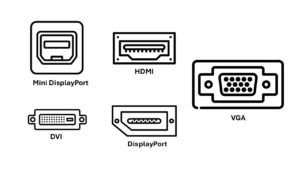
The 5 Most Common types of Display Inputs/Outputs are:
- Mini DisplayPort
- DisplayPort
- HDMI
- VGA
- DVI
Display Port: #
DisplayPort is shaped like the letter ‘D’ and designed for high-resolution displays and high refresh rates, supporting features like multiple monitor connections, high bandwidth, and can carry USB data and power over a single cable. Key advantages include a locking connector for a secure connection, support for advanced features like HDR, and versatility via adapters to DVI or HDMI.

Mini Display Port: #
Mini DisplayPort (Mini DP) is a miniaturized version of the standard DisplayPort digital video interface, first introduced by Apple in 2008, designed for smaller devices like laptops and tablets. Also Commonly found on Graphics Cards.

HDMI: #
HDMI stands for High-Definition Multimedia Interface, and it’s a standard for transmitting high-quality audio and video signals. It was developed by Hitachi, Matsushita, and Sony to replace analog audio/video cables like the DVI connector, which is still used in some applications.

VGA: #
VGA, or Video Graphics Array, is a standard display interface and connector for computers that uses an analog signal to transmit video to a display device. It features a distinct 15-pin D-subminiature connector usually blue in colour but can also be Black.

DVI: #
DVI, or Digital Visual Interface, is a video connector standard developed in the late 1990s to transmit uncompressed digital video signals from a source like a computer to a display such as a monitor or projector. DVI cables usally with White coloured connectors come in types that support digital-only (DVI-D), digital and analog (DVI-I), or analog-only (DVI-A) signals, though analog types are now mostly obsolete.